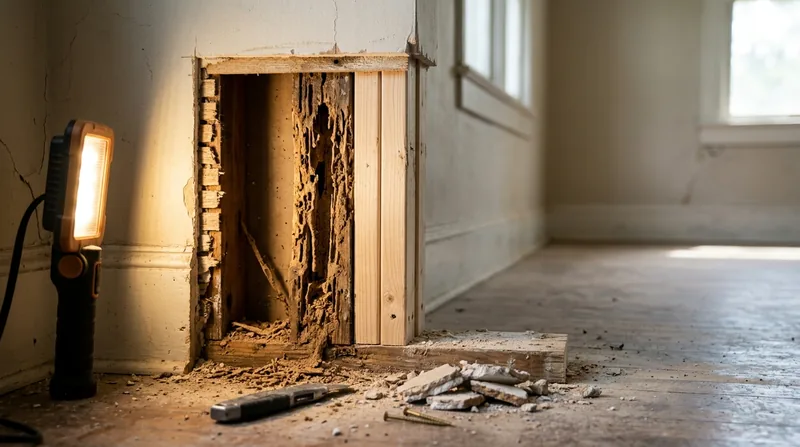




Formosan and eastern subterranean termites stay active year-round across Charleston's older homes, eating through sill plates, floor joists, studs and trim from the inside out. After your pest inspector confirms the infestation and the exterminator treats it, the damaged wood remains. Termite damage repair in Charleston means replacing compromised framing, subfloor sections, sills and trim to restore structural integrity and prevent settlement or further decay. We work from your pest inspection report, remove the eaten wood, sister new framing where possible, and replace where the damage runs too deep. Charleston's low peninsula, salt air, damp crawlspaces and subtropical humidity create year-round conditions that keep termites feeding and wood vulnerable. Whether your home sits on raised brick piers in Hampton Park Terrace, over a vented crawlspace in West Ashley, or on pilings on Folly Beach, termite damage follows the same pattern: the wood softens, loses strength, and the house begins to settle. We repair it back to solid.
Why Termite Damage Repair Matters in Charleston's Older Homes
Charleston sits on a peninsula wrapped by salt marsh, with a hot, humid subtropical climate and long wet summers. King tides and storm surge reach many streets, keeping crawlspace framing damp year-round. Both Formosan and eastern subterranean termites thrive here, working silently through floor joists, rim joists, sill plates and studs. Once the exterminator finishes treatment, the structural damage remains. Leaving it in place allows the house to settle unevenly, doors and windows to stick, and floors to sag. Replacing the wood now prevents compounding damage and keeps the frame plumb.
- We remove termite-eaten studs, sills and rim joists and replace them with pressure-treated or solid wood to restore load-bearing capacity.
- We sister new floor joists alongside compromised existing joists to restore stiffness and eliminate bounce in the subfloor.
- We replace subfloor sections that have lost structural integrity, working around plumbing and electrical runs to preserve existing systems.
- We repair or replace trim, fascia and exterior casing damaged by termite activity, blending new wood to match the existing profile.
- We document all work with photographs and written notes to help you file an insurance claim if your policy covers termite damage.
Each repair restores the frame to full strength and stops the settlement that accelerates other failures across the house.
Key info: Charleston's narrow 18th- and 19th-century single houses and freedman's cottages carry heart-pine joists and old-growth timber that termites find irresistible. A single pest inspection report is your roadmap. We work directly from that report, replacing only the wood the inspector identified, and leaving sound wood in place wherever possible.
For more detail on wood damage repair across Charleston homes, see our wood rot and dry rot repair page.
How We Repair Termite Damage in Charleston Homes
We start with your pest inspection report and a site visit to confirm which framing members need attention. We then remove the damaged wood, measure and cut replacement pieces, and install them to the same dimensions and grade as the original. For floor joists and rim joists, we often sister new lumber alongside the compromised member rather than replace it entirely, preserving the existing framing and minimizing disruption. For studs, sills and exterior trim, we replace the piece outright. All new framing lumber is pressure-treated to resist future termite and moisture damage. We work around existing plumbing, electrical and HVAC runs to avoid costly rework downstream.
- We inspect the damage site and confirm the scope against your pest report before ordering materials or starting removal.
- We remove the damaged wood section using hand tools and power saws, taking care to preserve adjacent sound framing.
- We measure and cut replacement lumber to exact dimensions, matching the original grade and species where structural performance demands it.
- We install the new framing using fasteners appropriate to the connection, sistering joists with lag bolts or joist hangers as the existing framing requires.
- We backfill subfloor sections with CDX plywood, fastening it to the joists with ring-shank nails or screws to eliminate squeaking.
- We finish exterior repairs with caulk and paint to match the existing trim and protect the new wood from weather.
The entire repair sequence restores the wood to its original structural role and eliminates the soft spots and settlement that follow termite damage.
Local example: A 1920s bungalow in Wagener Terrace had termites in three floor joists under the front bedroom. We sistered new pressure-treated joists alongside each compromised member, bolted them in place, and installed a new subfloor section over the repair. The floor stopped bouncing and the house settled back to level. The work took two days and cost less than full joist replacement.
For detailed information on floor joist and subfloor repair, see our floor joist and subfloor repair page.
Termite Damage Repair Methods and Materials
| Approach | Description | Best for |
|---|---|---|
| Joist sistering | New pressure-treated lumber bolted alongside the compromised joist, spanning the full length of the damage and beyond. | Moderate termite damage to floor joists or rim joists where the existing wood still carries some load. |
| Full joist replacement | Removal of the entire joist and installation of new pressure-treated lumber cut to match the original dimensions and bearing points. | Extensive termite damage affecting more than half the joist depth or where the wood has lost structural integrity. |
| Stud and sill replacement | Removal of damaged studs and sill plates and installation of new pressure-treated lumber, secured with galvanized fasteners and bolts. | Termite damage to wall framing, sill plates or exterior trim where replacement is faster and more reliable than repair. |
| Subfloor section replacement | Removal of damaged subfloor plywood and installation of new CDX plywood, fastened to the joists with ring-shank nails or screws. | Termite damage to the subfloor itself, often combined with joist repair to ensure the entire floor assembly is sound. |
| Exterior trim repair | Replacement of fascia, soffit, trim boards and casing damaged by termites, with new wood matched to the existing profile and painted to match. | Visible termite damage to piazza columns, railings, sills and fascia on Charleston's historic single houses and cottages. |
Termite Damage Repair Cost in Charleston: What to Expect
Termite damage repair in Charleston starts at around $1,200 for a small, localized repair to a single joist or sill section and can reach $8,000 or more if multiple joists, rim joists and subfloor sections require replacement across a large crawlspace. The cost depends on how much wood is damaged, whether the repair is sistering or full replacement, access to the damage site, and whether plumbing or electrical lines run through the repair zone. A modest 1920s bungalow with termite damage to two or three floor joists typically runs $2,500 to $4,500. A larger Ansonborough home with damage across an entire crawlspace rim joist and multiple joists may run $5,000 to $8,000 or more. Getting two or three estimates from local carpenters is smart; you'll see variation in approach (sistering vs. replacement), material choices and timeline, and the lowest price is rarely the best value.
We include all labor, fasteners, pressure-treated lumber and finishing in our estimate. We do not charge separate fees for travel within Charleston and the surrounding service area. Permits are not always required for termite damage repair, but structural repairs to load-bearing walls or beams may need approval from the Charleston Building Department or your local jurisdiction. We can advise on whether a permit applies to your job and help you understand what the building department will require, but you should verify permit requirements with your local building department before we start work.
For a detailed breakdown of our pricing and what factors affect the cost of your specific repair, see our full pricing page.
Termite Damage Repair Near Me: What Charleston Homeowners Should Know When Hiring a Carpenter
When you're looking for a carpenter to repair termite damage in Charleston, North Charleston, Mount Pleasant, Summerville or nearby, start by asking whether the contractor is fully insured and can provide a certificate of insurance on request. Get at least two or three written estimates that spell out exactly which wood will be removed and replaced, what materials will be used, and how long the work will take. Check references from recent termite damage repairs, not just general carpentry work. Ask whether the contractor has experience with your home's era and construction type, whether it's an 18th-century single house, a 1920s bungalow, a 1950s ranch or a raised beach house. Ask about permits: some jobs need building department approval, and your contractor should be clear about which jobs do and how to get them. If your home is in a historic district, the Charleston Board of Architectural Review may have requirements for exterior repairs, so confirm that your contractor understands those rules before starting.
- Verify that the contractor carries liability insurance and workers compensation insurance and can show you a current certificate.
- Ask for references from three or more recent termite damage repairs and call them to ask about quality, timeline and cost accuracy.
- Request a written estimate that itemizes the work, materials and labor so you can compare apples to apples across contractors.
- Confirm that the contractor understands whether your repair requires a permit by asking them to explain the triggering factors for your specific job.
- Ask about the warranty on the work, whether it covers the new framing lumber and whether it covers labor if a repair fails within a set time.
The best contractor for termite damage repair is one who explains what the damage is, why it matters, and exactly how they will fix it, not one who rushes you into a decision or quotes the lowest price without detail.
Ready to get started? Contact us for a free estimate or call (843) 212-1020. We respond within 24 hours and there is no obligation to book.
Termite Damage Repair in Charleston: Pricing Guide
| Service | Price | Details |
|---|---|---|
| Small localized repair | Starting at $1,200 | One to two joists or sill sections, sistering or short-span replacement, minimal subfloor work |
| Moderate crawlspace repair | Starting at $3,500 | Three to five joists, rim joist section, subfloor patching, includes pressure-treated materials and fasteners |
| Large-scale structural repair | Starting at $6,500 | Multiple joists across a full crawlspace, extensive rim joist replacement, significant subfloor work, requires site assessment |
| Exterior trim and fascia repair | Starting at $1,800 | Damaged piazza columns, railings, sills and fascia on Charleston historic homes, includes matching and finishing |
| Travel and estimate | Included in Charleston area | No separate mileage fee or travel charge for service areas, free written estimate with no obligation to book |
Indicative pricing, the exact cost depends on square footage, finish, and site access. Free personalized estimate within 24h at (843) 212-1020.


