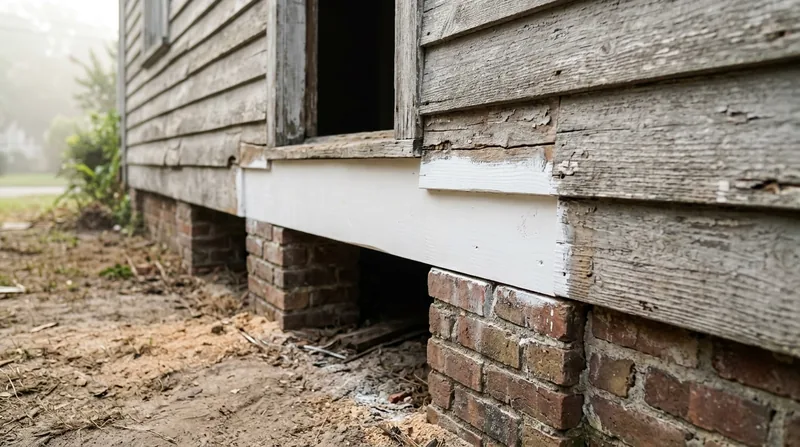




Wood rot and dry rot repair in Charleston is a constant necessity in a city where salt air, humidity, and tidal flooding attack wooden framing, siding, and trim year-round. Charleston's 18th- and 19th-century single houses, narrow piazzas, raised cottages on James Island and Folly Beach, and 1910s bungalows on brick piers all face the same enemy: moisture that penetrates wood, feeds decay, and weakens structural members. When rot takes hold in a floor joist, sill plate, rim joist, or fascia, the damage spreads quietly until the wood loses its strength. We cut out the decayed wood, treat surrounding framing to stop the rot's advance, and rebuild with rot-resistant lumber. This is a permanent repair, not a cosmetic patch, and it stops the decay before it reaches the frame.
Why Wood Rot and Dry Rot Demand Immediate Attention in Charleston's Climate
Charleston sits low between the Ashley and Cooper rivers, wrapped by salt marsh and exposed to king tides, storm surge, and a hot, humid subtropical climate that keeps crawlspace framing damp most of the year. Both Formosan and eastern subterranean termites thrive here year-round, but wood rot itself is the more pervasive threat to the city's residential stock. Salt air corrodes fasteners and penetrates painted wood; wind-driven rain from tropical storms and hurricanes soaks piazza columns, railings, sills, and fascia; and the constant moisture in crawlspaces and under raised foundations creates the perfect environment for fungal decay to take hold. Heart-pine floor joists, old redwood trim, and Douglas fir studs all soften and lose their load-bearing capacity as rot spreads.
- Decayed wood loses structural strength and cannot safely support weight or resist lateral forces from wind and settling.
- Rot spreads laterally through wood and can jump to adjacent framing if the surrounding wood is not treated and monitored.
- Salt air and moisture make Charleston's exterior trim and piazza framing vulnerable to accelerated decay compared to inland regions.
- Soft, punky wood is a sign that decay has already advanced; repair becomes more expensive the longer rot is left untreated.
Addressing rot early keeps repair costs down and prevents the damage from compromising the structural integrity of your home.
Key info: Termite damage and wood rot are different pathologies. Termites consume wood from the inside and leave hollow galleries; rot is fungal decay that softens wood fibers. If you suspect termites, get a professional pest inspection and work from that report. See our termite damage repair page for more detail on how we address the structural damage termites leave behind.
For guidance on permits and inspections, check with the City of Charleston Building and Planning Department if your repair involves structural alterations or historic district approval.
How We Repair Wood Rot: Our Process from Assessment to Rebuild
We start by identifying the full extent of the decay, which often spreads beyond what is visible on the surface. We tap the wood, probe soft spots, and trace the rot back to sound wood. Once we know where the decay ends, we cut out all compromised framing, siding, or trim. We then treat the surrounding wood with a wood preservative to stop fungal spread, allow the area to dry, and rebuild with pressure-treated lumber, cedar, or redwood depending on the location and exposure. The rebuilt section is sealed and finished to match the existing structure.
- We expose and assess the rot by cutting inspection windows and probing the wood to find the boundary between soft decay and sound framing.
- We remove all decayed wood, taking care to preserve structural members that can be saved by sistering or reinforcement.
- We treat surrounding wood with a fungicide and allow the repair area to dry before rebuilding to prevent rot from recurring.
- We rebuild with rot-resistant lumber species and ensure proper ventilation and drainage so moisture does not re-accumulate.
- We seal and finish the repair to blend with existing trim and protect the new wood from future water intrusion.
The result is a repair that stops decay and restores full structural function to the damaged area.
Local example: A homeowner in Ansonborough noticed soft spots in the fascia and soffit of a 1920s single house. We opened the soffit, found rot extending back into the rafter tails where wind-driven rain had worked past the paint. We cut out the decayed wood, treated the rafters, and rebuilt the fascia and soffit with cedar and stainless fasteners to resist salt air. The repair took three days and cost $2,100. Without the repair, the rot would have spread to the roof framing within two years. See our fascia and soffit repair page for more on exterior trim issues.
Wood Rot Repair Methods
| Approach | Description | Best For |
|---|---|---|
| Selective removal and rebuild | Cut out only the decayed section, treat surrounding wood, and rebuild with new framing or trim. | Rot limited to one joist, section of rim board, or trim piece; structural member is otherwise sound. |
| Sistering and reinforcement | Install a new sister joist or beam alongside a weakened member to restore load-bearing capacity. | Decay affects part of a floor joist or beam; the member can be preserved and reinforced. |
| Full member replacement | Remove and replace an entire joist, beam, sill plate, or header if rot is extensive or decay has compromised the full section. | Rot extends across the entire depth or length of a structural member; repair is not feasible. |
| Exterior trim and fascia renewal | Cut out decayed fascia, soffit, siding, or railing; treat the underlying framing; rebuild with rot-resistant species and stainless hardware. | Salt air and moisture have degraded exterior finish carpentry; structural framing is still sound. |
Wood Rot and Dry Rot Repair Cost in Charleston: What to Expect
Wood rot repair in Charleston starts at around $650 for a small, localized repair such as a section of fascia or a single damaged stud. Larger jobs involving floor joists, sill plates, or multiple structural members typically run $1,500 to $4,000 depending on the extent of decay, access to the damaged area, and whether the repair involves sistering, full replacement, or exterior rebuild. Factors that affect cost include the size and species of the damaged member, how deep the rot has spread, whether the repair is in a crawlspace (harder to access), and whether the area needs to be opened up or shored during the work.
A full floor joist replacement in a 1950s ranch house crawlspace in West Ashley might run $2,200 to $3,500; a piazza column replacement in a historic single house in South of Broad could be $1,800 to $2,800 depending on height and ornamentation. Exterior trim and fascia repair on a raised beach house in Folly Beach or Sullivan's Island typically runs higher because of salt air exposure, the need for rot-resistant species, and stainless hardware. The best way to know your actual cost is to get two or three estimates from local carpenters who can see the damage in person and understand the scope. See our full pricing page for more detail on how we structure estimates.
Wood Rot and Dry Rot Repair Near Me: What Charleston Homeowners Should Know When Hiring a Carpenter
When you hire a carpenter for wood rot repair, verify that they are fully insured and ask to see a certificate of insurance before work begins. Get at least two estimates and ask each carpenter to explain what they plan to cut out, what they will treat, and what species they will use to rebuild. If your home is in a historic district in Charleston, North Charleston, or Summerville, check whether your repair needs approval from the local architectural review board before work starts. If you live in an HOA community, review your deed restrictions to see whether exterior changes need approval. Ask for references from recent jobs and follow up with at least one homeowner to confirm the work quality and timeline.
- Verify that your contractor carries liability insurance and workers compensation coverage, and request proof before signing a contract.
- Ask for a detailed written estimate that breaks down what will be removed, what will be treated, what materials will be used, and what the timeline is.
- Confirm whether the repair requires a permit by checking with your local building department; structural repairs often do, and permits protect you.
- If your home is in a historic district or HOA, verify that the repair plan complies with architectural guidelines or deed restrictions before work begins.
- Ask the carpenter to explain their warranty on the repair and what they will do if rot reappears in the treated area.
A good local carpenter will take time to explain the problem, show you the decay, and propose a repair that is honest about what can be saved and what needs to be replaced. Call us at (843) 212-1020 for a free, no-obligation estimate, or visit our contact page to request an appointment.
Wood Rot & Dry Rot Repair in Charleston: Pricing Guide
| Service | Price | Details |
|---|---|---|
| Small localized repair | Starting at $650 | Single section of trim, fascia, or one damaged stud; includes removal, treatment, and rebuild with rot-resistant lumber |
| Floor joist or rim board repair | Starting at $1,500 | Selective removal and sistering or full replacement of one joist or rim section; includes access, treatment, and structural reinforcement |
| Exterior trim and piazza column work | Starting at $1,800 | Fascia, soffit, siding, or column replacement; includes rot-resistant species, stainless hardware, and salt-air protection in coastal areas |
| Large-scale structural repair | On estimate | Multiple joists, beam replacement, or extensive crawlspace framing decay; requires on-site assessment to determine scope and cost |
| Travel and inspection | Included | No mileage fee or travel surcharge for estimates and work in Charleston and surrounding service areas |
| Free estimate | No obligation | Response within 24 hours at (843) 212-1020; we assess the damage and provide a detailed written estimate before you commit |
Indicative pricing, the exact cost depends on square footage, finish, and site access. Free personalized estimate within 24h at (843) 212-1020.


