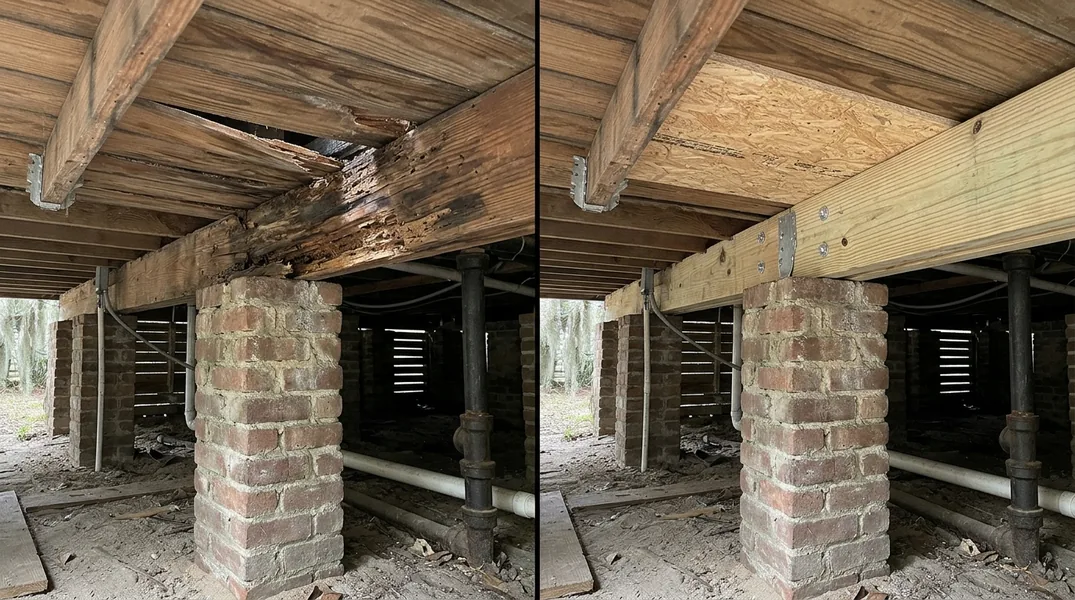
Why Charleston's Old Homes Develop Sagging Floors
If you own a historic home in Charleston, you've likely noticed a slight dip or bounce in the floorboards. That's not just character; it's often a structural warning sign. Sagging floors in older homes typically stem from three interconnected problems: moisture intrusion in crawlspaces, wood rot in floor joists, and deteriorating support systems like brick piers.
The culprit is almost always moisture. Charleston's subtropical climate, combined with high water tables and coastal humidity, creates the perfect storm for wood decay. When moisture seeps into a crawlspace (and it almost always does in older homes), it softens the wood fibers of floor joists and beams. Over time, this weakens their load-bearing capacity, causing the floor above to sag incrementally. What started as a minor sag can become a serious structural liability if left unaddressed.
Understanding Crawlspace Moisture and Its Impact on Floor Joists
Your crawlspace is ground zero for floor problems. Many older Charleston homes were built with minimal or no vapor barriers, meaning soil moisture rises freely into the wooden framing. Even homes with plastic sheeting often have gaps, tears, or improper installation. When relative humidity in a crawlspace climbs above 60 percent, wood begins to absorb moisture and become vulnerable to fungal growth and decay.
Floor joists are the beams that span between foundation supports and carry the weight of your home's floors and contents. When exposed to persistent moisture, these joists lose their structural integrity. The wood becomes soft, spongy, and unable to resist the loads pressing down from above. This is where Floor Joist & Subfloor Repair becomes critical. A professional inspection can reveal which joists have compromised strength and need reinforcement or replacement. Ignoring this stage often leads to more expensive repairs down the road, as additional joists and support beams may fail.
Brick Piers, Settlement, and Structural Failure
Many Charleston homes rest on brick piers rather than solid concrete foundations. While these masonry supports have stood for 100+ years in some cases, they're not immune to failure. Brick piers can settle unevenly, crack, or crumble as mortar deteriorates. When a pier fails, the floor joist it supports loses its bearing point, and the floor above begins to sag dramatically. You might notice a sudden drop or a pronounced wave in the floorboards near a failing pier.
The brick itself may still look sound from above, but moisture and age take their toll on the mortar joints. Repointing (replacing the mortar) can extend pier life, but severely compromised piers often require Beam Replacement & Load-Bearing Wall Removal work to install new concrete or steel support posts. This is structural work that demands professional assessment and engineering-backed solutions. Attempting DIY fixes on piers or sagging floors can be dangerous and may even violate building codes in your jurisdiction.
Sistering Floor Joists: A Proven Repair Strategy
One of the most effective and cost-efficient ways to address sagging floors is sistering. This involves bolting a new or reinforced joist alongside a weakened or partially rotted joist to restore load-bearing capacity. The new sister joist shares the structural burden, effectively doubling the strength of that span. Sistering works well for joists that have moderate decay or deflection but still have some structural integrity remaining.
The process requires precise measurement, proper sizing of the sister joist, and careful installation using structural fasteners. It's not a quick fix; it's an engineered solution that restores the floor to proper level and stability. Many homeowners are surprised to learn that sistering can be completed without replacing the entire joist, making it a practical middle ground between band-aid solutions and full replacement. However, this work should only be performed by experienced carpenters who understand load paths and building codes. If you're seeing floor sag and suspect weakened joists, a free estimate from a qualified contractor is your first step.
Wood Rot & Dry Rot Repair Near Me: When to Call a Professional
Not all floor sag is equal. Some homes experience minor settling that doesn't worsen over decades, while others face active Wood Rot & Dry Rot Repair that progresses quickly. The difference often comes down to moisture control and the extent of existing decay. If you tap a floor joist with a screwdriver and the blade sinks in easily, that's rot. If the floor is noticeably softer or bouncy in certain spots, structural failure may already be underway.
Professional assessment is non-negotiable for sagging floors. A trained carpenter can probe joists, measure deflection, inspect piers, and evaluate crawlspace conditions to determine the root cause and appropriate remedy. In Charleston, where moisture is relentless and older construction is common, this expertise is invaluable. Some repairs require structural engineering drawings; others need building permits. A reputable contractor will guide you through these requirements and ensure the work meets current codes.
Getting Started: Inspection, Repair Planning, and Next Steps
The first step is a thorough inspection. You'll want a contractor to examine the crawlspace, measure floor deflection, check for active moisture, and identify rotted or damaged joists. This inspection typically takes an hour or two and forms the basis for a repair plan and estimate. Charleston Carpentry offers comprehensive evaluations and can explain findings in plain language so you understand the problem and your options.
Once you have a clear picture of the damage, repair priorities become clear. Some homes need immediate crawlspace encapsulation and vapor barrier work to stop moisture before structural repairs begin. Others require sistering or partial joist replacement first, followed by moisture control. The sequencing matters; fixing joists without addressing the moisture source is like patching a roof leak without finding the hole. Ready to take action? Call Charleston Carpentry at (843) 212-1020 or request a free estimate today. We serve the greater Charleston area and can help you restore your home's structural integrity with proven, lasting solutions.
Looking for a professional carpentry contractor in Charleston? Charleston Carpentry responds fast for all your carpentry needs.
Get a Free QuoteOur services: Wood Rot & Dry Rot Repair · Termite Damage Repair · Floor Joist & Subfloor Repair